Choosing between environmental chamber hire and buying is rarely just a question of monthly cost versus purchase price. The right route depends on how long you need the equipment, how fixed your test profile is and whether your organisation needs permanent in-house capacity.
For a short project, a temporary increase in test workload or a requirement that may change during development, hiring can provide a practical way to access chamber capacity without committing to ownership. For regular, long-term testing, buying a new or used environmental test chamber can offer greater control over specification, scheduling and lifecycle planning.
This guide compares the main options so that procurement teams, engineers and laboratory managers can choose a route that fits both the test programme and the wider business case.
Hire for flexibility, buy for regular long-term use
Environmental chamber hire often makes sense where testing is short-term, demand is uncertain or a business needs additional capacity quickly. It can also be useful for trials, validation work, breakdown cover or projects where capital expenditure needs to be controlled.
Buying is usually the stronger option where a chamber will support ongoing R&D, quality assurance or production-related testing. Ownership gives the business a dedicated asset that can be specified around its routine test conditions, product size and monitoring needs.
There is however a third option that’s worth evaluating. A used environmental chamber can provide a middle ground for organisations that need permanent equipment but don’t need a brand-new chamber. ETS also offers a rent-with-option-to-buy route, which can help where the project begins with uncertainty but may develop into a long-term requirement.
| Decision factor | Hire an environmental chamber | Buy a new chamber | Buy a used chamber |
|---|---|---|---|
| Typical use | Short projects, temporary capacity, trials and changing needs | Regular or long-term testing | Ongoing testing with a tighter capital budget |
| Upfront commitment | Lower initial commitment | Higher initial investment | Often lower than buying new, subject to available stock and condition |
| Flexibility | High, particularly where project length or test needs may change | Best where the requirement is established | Depends on the available chamber and how closely it matches the application |
| Specification choice | Limited to suitable current hire options | Greater scope to match the chamber to the test profile | Depends on the specification of available used equipment |
| Ongoing support | ETS hire includes technical support, with no service or maintenance costs during the hire arrangement | The owner needs to plan for service, maintenance and calibration | Support, condition and calibration options need confirming for the individual chamber |
| Long-term value | Can become less cost-effective for sustained, predictable use | Can be justified where use is frequent and long-term | Can offer a practical ownership route where the available specification fits |
The comparison starts with project duration, but it shouldn’t end there. A chamber that is inexpensive to hire isn’t necessarily the right choice if it can’t accommodate the load, achieve the required temperature and humidity profile or provide the necessary data records. Equally, a purchased chamber can become an underused asset if the testing programme ends sooner than expected.
When environmental chamber hire makes sense
Hiring tends to be the preferred route when the immediate requirement is clear but the long-term picture isn’t. A development programme may need temperature or humidity testing for a defined period, for example, while a prototype is being evaluated or a product is working through a validation stage.
It’s also useful for absorbing temporary pressure on equipment you already own. If an existing chamber is fully booked, being serviced or simply too small for a larger product, a hire chamber can add capacity without holding up the wider programme.
Short or one-off test programmes
A fixed-duration project is one of the clearest cases for test chamber hire because the business can focus its budget on completing the required testing rather than purchasing equipment that might not be needed once the programme closes.
Before arranging hire chambers, it’s worth establishing the likely project length and whether there is a realistic risk of extension. This affects the commercial comparison, but it also helps ETS identify a chamber route that can support the full test schedule.
Changing development requirements
Early-stage development is often uncertain by nature. Test conditions can shift as a design develops and the required working volume can grow once prototypes move from individual components to assembled units.
An environmental chamber hire arrangement can provide flexibility while the final specification is still being defined. Even so, it’s worth providing the expected temperature range, humidity conditions, product dimensions, load and test duration up front, so the right chamber can be matched to the job.
Temporary capacity and breakdown cover
Hiring can also protect a test programme where an existing chamber is unavailable because of planned maintenance, an unexpected fault or a temporary rise in workload.
The value here isn’t only access to equipment but the ability to keep critical validation, reliability or quality work moving while the longer-term situation is resolved. ETS hire chambers include technical support and avoid separate service or maintenance costs during the hire arrangement.
Trialling the practical fit
A chamber can look perfectly suitable on paper and still cause problems once the product is loaded in. The internal volume needs to accommodate the item while retaining sufficient clearance for airflow. Shelving, cable ports, access arrangements and data logging can also affect whether the setup works in practice.
Hiring can be a sensible way to test the operational fit before committing to a permanent purchase. This is especially useful where the application is new, the test profile has not been fully proven or several chamber configurations are being evaluated.
When buying a chamber is the better option
Buying tends to make more sense once testing becomes regular, forecastable and central to day-to-day operations. Owning a chamber gives the team more control over access, scheduling and specification than any hire arrangement can offer.
That doesn’t mean every regular user needs a brand-new chamber, though. The real decision comes down to the balance between expected operating life, the technical fit required and the budget available.
Ongoing testing programmes
Where a laboratory or production team runs continuous testing, repeated hire arrangements can end up being less practical than simply owning the equipment. A purchased chamber can be planned around routine demand instead of being coordinated around individual projects each time.
Buying also helps where test schedules are difficult to shift. If several teams need regular access to the same equipment, having a chamber on site makes planning considerably more predictable.
A defined and specialist test profile
New chambers usually make the most sense once the test profile is established and the application has specific requirements, whether that’s a particular temperature range, controlled humidity, chamber size, rate of change, load arrangement or monitoring set-up.
A new environmental test chamber can be chosen around those needs rather than constrained by the equipment currently available for hire. The technical case should still start with the actual test profile, not with a broad chamber category.
Long-term control of equipment and records
Ownership can make sense where the business wants to establish its own operating procedures, maintenance planning and data-recording arrangements around a permanent test asset. This may be relevant where multiple projects rely on repeatable methods or where a team needs dependable access to historic test information.
The chamber itself is only one part of that decision. Plan for installation space, electrical supply, site access, calibration needs, service support and any controller or data logging requirements before committing to a purchase.
Where used chambers fit in
Used equipment can offer a practical ownership route for organisations that have ongoing testing needs but don’t need a newly specified chamber. It may be relevant where a suitable chamber becomes available with a range, volume and configuration that closely match the intended application.
The trade-off is that the available equipment may not align exactly with every test condition. A used chamber needs to be assessed on its actual specification, physical condition, controller, service history, refrigeration condition, calibration status and support options before a purchase decision is made.
Used chambers are therefore not simply a lower-cost version of buying new. They are a separate route that works best where the available equipment provides a sound technical fit without compromising the test programme.
The rent-to-buy option
Some projects don’t fit neatly into a hire-or-buy decision so a business may need a chamber immediately for a defined programme, but expect demand to continue if the product moves into the next development phase or production.
In that situation, a rent-with-option-to-buy route can reduce the pressure to make a full purchase decision at the outset. It gives the team an opportunity to establish whether the chamber supports the real workload, access arrangements and testing process before deciding on longer-term ownership.
The applicable terms and the suitability of this route need to be confirmed for the individual requirement. Start with the project duration, expected future demand and the chamber specification needed from day one.
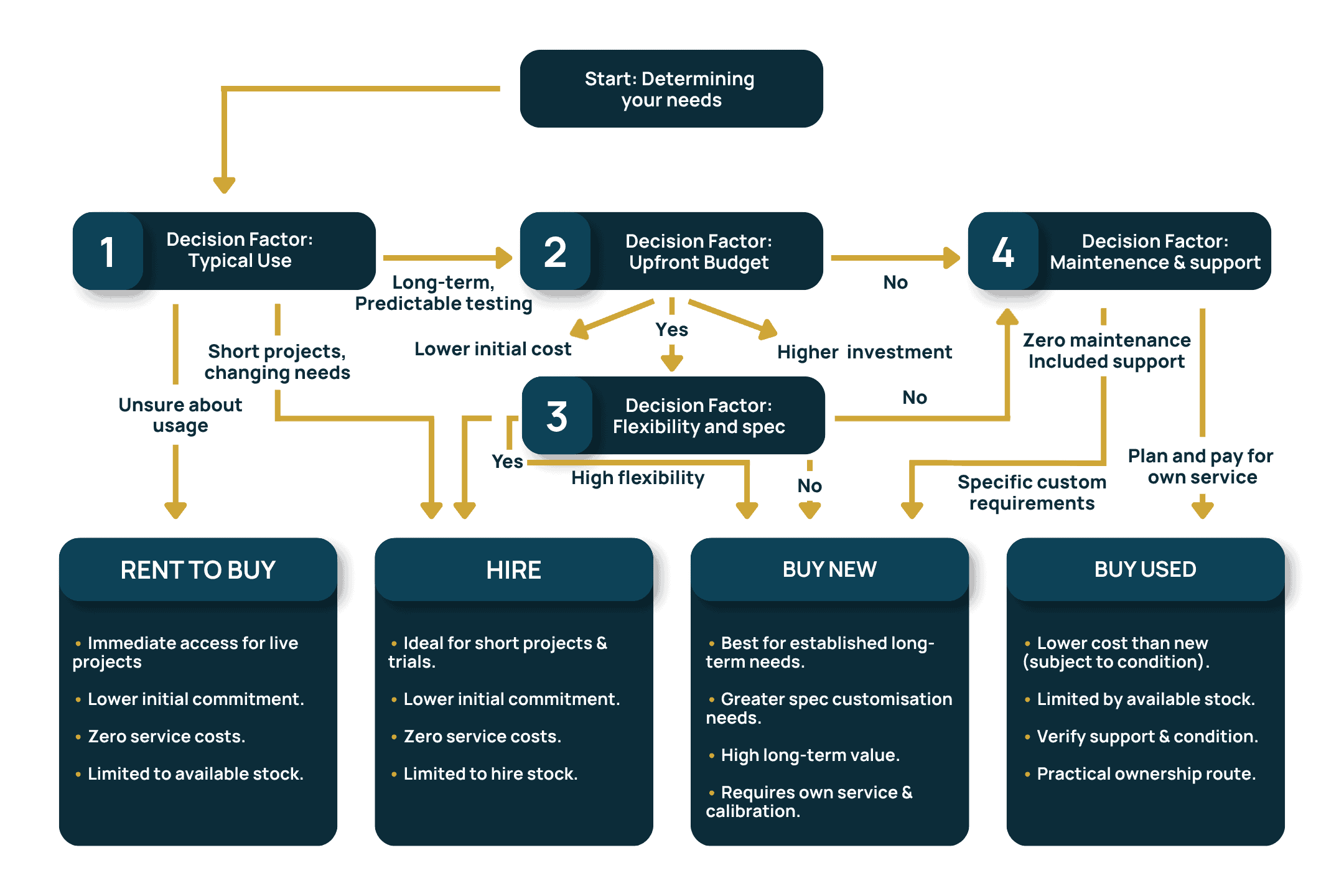
Practical questions before deciding
A clear brief makes it easier to compare environmental chamber rental, purchase and used equipment on a like-for-like basis. Before requesting a quote or discussing options, define:
- The test profile – required temperature range, humidity conditions, dwell periods, cycling and any rate-of-change needs.
- The product under test – dimensions, weight, heat output, cabling and the clearance needed to maintain airflow.
- Project duration – whether the requirement is a few weeks, several months or part of a continuing programme.
- Frequency of use – whether the chamber will be used occasionally, continuously or by several teams.
- Site constraints – available floor space, access for delivery, power supply and any water or drainage needs.
- Data and traceability needs – controller functions, monitoring, data logging and calibration expectations.
- Future demand – whether product development, production volume or test standards are likely to change.
These factors interact more than they might first suggest. A chamber may have enough physical space for the product but not enough clearance for reliable airflow around it, and a hire unit that fits the current programme may not stretch to cover the next phase. Working out the likely direction of travel early helps avoid choosing a solution that only fits today’s conditions.
If the application is still being developed, ETS can use the test profile to help identify whether hire, a rent-to-buy route, used equipment or a new chamber is the most justified starting point. The chamber search tool can also help structure the initial equipment enquiry.
Common mistakes to avoid
Choosing only on project length
Project duration matters, but it isn’t the only factor. A six-month project with demanding temperature, humidity or capacity needs may require a different decision from a six-month project using a straightforward, widely available chamber configuration.
Assuming the product only needs to fit inside
Working volume isn’t the same as usable test space. The load must fit with practical airflow clearance, access for cables or sensors and space for shelves or fixtures where needed.
Treating hire availability as fixed
Hire fleets change as chambers move between projects, return from site or undergo preparation. Confirm current availability and the suitability of the actual chamber before finalising the test plan.
Overlooking what happens after the initial project
A short programme can become a permanent requirement. It is worth discussing the potential next stage early, particularly where a rent-to-buy route or used chamber option could provide a better transition than starting the selection process again.
Discuss the right route for your project
The best choice isn’t always hire or buy. It may be a short-term hire arrangement, rent-with-option-to-buy, a used chamber or a newly specified environmental test chamber.
Contact ETS to discuss your test profile, required capacity, temperature and humidity conditions, project length and site requirements. ETS can then help you compare the most practical hire, purchase and used-equipment options for your application.
FAQs
When should I hire rather than buy an environmental chamber?
Hire is often the better route for short-term testing, temporary capacity, development work or projects with an uncertain duration. Buying is more likely to make sense where chamber use is regular, long-term and based on an established test profile.
How much does environmental chamber hire cost?
The cost depends on the chamber type, required specification, hire duration, delivery location and support needs. ETS can provide a quotation once the required temperature range, humidity range, capacity and project length are known.
What is included with chamber hire?
ETS hire includes technical support, with no separate service or maintenance costs during the hire arrangement. The exact scope, chamber specification, delivery arrangements and current availability need to be confirmed for the project.
Can I convert a hire chamber into a purchase?
ETS offers a rent-with-option-to-buy route. Whether this is the right option depends on the chamber, project duration and likely future demand, so discuss the intended use with ETS before committing.
How long can I hire an environmental test chamber for?
Hire duration depends on the project and current equipment availability. Share the anticipated start date and test schedule with ETS so that the most practical route can be discussed.
Frequently Asked Questions
- When should I hire rather than buy an environmental chamber?
Hire is often the better route for short-term testing, temporary capacity, development work or projects with an uncertain duration. Buying is more likely to make sense where chamber use is regular, long-term and based on an established test profile.
- How much does environmental chamber hire cost?
The cost depends on the chamber type, required specification, hire duration, delivery location and support needs. ETS can provide a quotation once the required temperature range, humidity range, capacity and project length are known.
- What is included with chamber hire?
ETS hire includes technical support, with no separate service or maintenance costs during the hire arrangement. The exact scope, chamber specification, delivery arrangements and current availability need to be confirmed for the project.
- Can I convert a hire chamber into a purchase?
ETS offers a rent-with-option-to-buy route. Whether this is the right option depends on the chamber, project duration and likely future demand, so discuss the intended use with ETS before committing.
- How long can I hire an environmental test chamber for?
Hire duration depends on the project and current equipment availability. Share the anticipated start date and test schedule with ETS so that the most practical route can be discussed.